About ON LiMiT
What is ON LiMiT?
ON LiMiT (Optimal Non-pharmacological LifeStyle Modifications in people with type 2 diabetes) is a large randomized controlled intervention study conducted in collaboration with the Steno Diabetes Centres in Aarhus, Odense, and Copenhagen, as well as the University of Copenhagen and Bispebjerg Hospital.
The aim of the trial is to investigate whether it is possible to achieve and maintain remission of type 2 diabetes through weight loss and lifestyle changes.
The project runs from 2025 to 2030 and involves approximately 1,500 participants with type 2 diabetes.
Why ON LiMiT?
The increasing prevalence of type 2 diabetes places pressure on the healthcare system and affects patients’ quality of life. In 2023, there were 323,094 people with type 2 diabetes in Denmark, and within the last 12 months, 25,001 people have been diagnosed with the disease. In addition, it is estimated that a further 100,000 people are living with undiagnosed type 2 diabetes. Weight loss and lifestyle changes have been shown to lead to remission, but knowledge is lacking regarding how remission can best be maintained.
What is diabetes remission?
Remission is defined as measured HbA1c <48 mmol/mol (long-term blood glucose) for at least 3 months after discontinuation of diabetes medication.
What does the trial involve?
Participants will first undergo a 12-week weight loss program using a very low-calorie diet, with the aim of achieving a weight loss of more than 10% of their body weight. Subsequently, participants will be randomly allocated to one of four groups:
- A carbohydrate-reduced diet combined with exercise
- A carbohydrate-reduced diet without exercise
- A carbohydrate-rich diet combined with exercise
- A carbohydrate-rich diet without exercise
Participants’ results will be compared with results from trial subjects who follow standard treatment and who have not undergone a weight loss program.
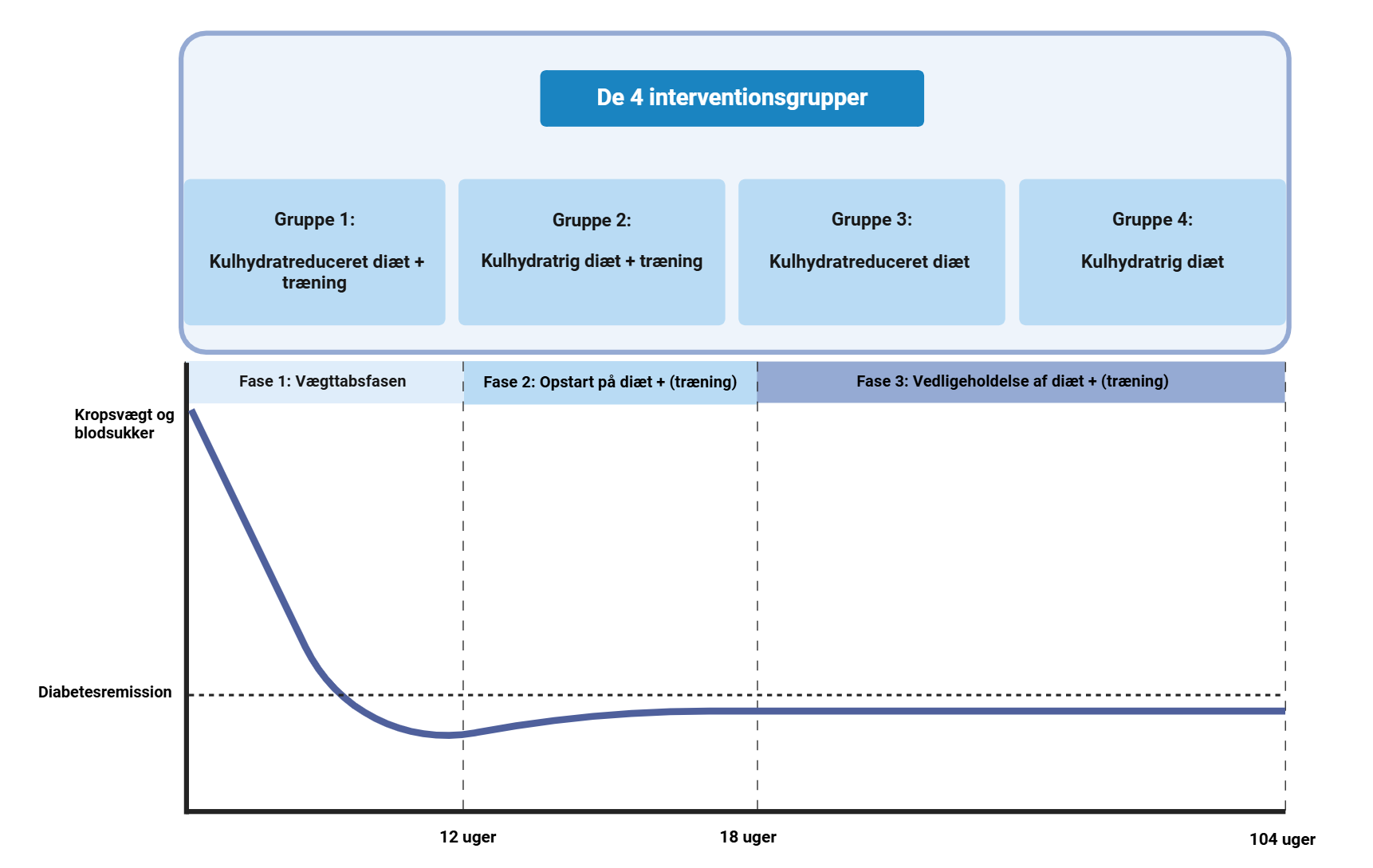
Read more about the intervention below:
Dietary intervention
The goal is to achieve a 25 E% difference in carbohydrate intake between the two diets.
Participants on the carbohydrate-reduced diet must consume a maximum of 25–30 E% from carbohydrates, while participants on the carbohydrate-rich diet must consume at least 50–55 E% from carbohydrates. There will be no restrictions on intake of fat, protein, or dietary fiber, but added sugar should be limited to <5 E% in both diets.
Participants will still be advised to follow recommendations for high-quality carbohydrate and fat intake in accordance with dietary guidelines for diabetes.
To make the diets more sustainable, a large proportion of the protein content will come from non-animal sources.
Exercise intervention
Participants are instructed to participate in three exercise sessions per week, including two supervised 60-minute sessions and one unsupervised session, during which a smartwatch is used to monitor intensity. Exercise must be performed at an intensity above 70% of maximal heart rate and/or reach a score of at least 7 on the Rating of Perceived Exertion (RPE) scale. For resistance training, this corresponds to having 1–3 repetitions in reserve or an intensity classified as vigorous according to the American College of Sports Medicine.
The focus will be on high-intensity aerobic exercise performed intermittently rather than as a fixed combination of aerobic and resistance modalities. Although a combined approach is more effective at reducing HbA1c than each modality alone, high-intensity aerobic exercise is prioritized in cases where adherence to resistance training is challenging or where facility access does not allow resistance training.
Expected results The primary aim is to investigate the proportion of participants who achieve medication-free remission after 104 weeks (2 years) in the group receiving a carbohydrate-reduced diet combined with exercise, compared with the control group.
In addition, other parameters will be examined, such as changes in HbA1c, time until HbA1c exceeds 48 mmol/mol, body weight, any type of remission (with or without medication), clinical risk markers (waist circumference, body fat, blood pressure, blood lipids, kidney function), glucose homeostasis, health economics, and the environmental impact of the diets.
Future application
Since weight loss is central to remission, we will test a new approach in which we induce a substantial initial weight loss using low-calorie meal replacements, followed by healthy and sustainable dietary regimens combined with structured exercise to maintain remission. We apply the latest knowledge on carbohydrate reduction and exercise to develop an effective remission plan for people with type 2 diabetes, which aims to be cost-effective, sustainable, and acceptable to individuals and society. We expect that the intervention can be implemented in Denmark as well as in other countries with comparable healthcare systems.
Hopefully, the trial will contribute to a reduced need for medical treatment, improved overall health, new recommendations for lifestyle-based remission of type 2 diabetes, and a cost-effective approach that is implementable, scalable, and acceptable to patients with type 2 diabetes.
Funding
ON LiMiT is funded by the Novo Nordisk Foundation. The grant amounts to DKK 101,811,237. This sum covers the dietary and exercise intervention as well as staff salaries.